Sunday, June 19, 2011

Urban Ocean Festival 2011

Here's my contribution to the Urban Ocean Festival at the Aquarium of the Pacific.


One of the more fun murals done in about ~12 1/2 hours over 2 days. Part of the Art Miles Mural Project, an amazing project bringing art to children all around the world. I was one of the live artists to draw people in while kids and families were welcome to join in on the fun with one of our other canvases set up to paint.

Thanks to all the volunteers and staff that helped out. Couldn't of pulled off such a speedy mural without all the help I received with water changes, paint distributing, and canvas moving. Everyone was awesome!

The theme was Urban Ocean and I started out with the thought of gears in the ocean and a couple of photos from the Monterey Bay Aquarium of a wolf eel skeleton and an octopus. One of my fastest murals and paintings to date. I had a lot of fun, with free reign and creativity that I don't normally get on work projects.

Friday, December 03, 2010

Fun Fish in Black and White

These are from a while ago now, maybe a couple months ago, but I was going through the education list of fish illustrations they didn't have and chose my favorites to start off with. For me, pen and ink is a very calm affair, zen-like almost. Turn on the music/podcast and slowly watch a piece develop under your hands. The time frame for these illustrations was more than usual since I was just filling time between projects, so they're more detailed than I would normally get.

The best of the recent black and white illustrations:

A frogfish.
They move around on their fins like they're part walking, part hopping along the ocean floor. They're also related to anglerfish and are ambush predators with a lure on their head.


A Pacific spiny lumpsucker.
These guys always remind me of muppets. A very cute fish. Their disk shaped ventral fin lets them hold onto rocks in high tide areas.


A wolf eel.
Not truly an eel—they have pectoral fins—these guys have some brilliant orange and brown colors with blue-green eyes as babies and then turn into grey, spotted, heavy-jawed animals as adults.

Friday, November 12, 2010

Tuco-tuco


A subterranean rodent that lives in South America, the tuco-tuco of the family Ctenomyidae.
Fulfilling an old request to draw one in black and white.

Friday, September 03, 2010

Garden Signage: Non-Plant Illustrations

Here are a few close-ups of the non-plant ID images used in the Garden signage.

Food waste that can be used for composting. This image was a simple pencil sketch composed from various photos and colored in Photoshop.


Compost and worms. Again, a simple sketch composed from various worm and compost photos, colored in Photoshop.


Organic pesticides. Usually when I do a vector image of an existing object, I start out with a trace of a photo of the object, usually low res, and adjust accordingly.


A close up of the home with the programmable drip irrigation box. Composed from various Illustrator and Photoshop elements.

Friday, August 27, 2010

Garden Signage

Here following are the Aquarium's garden signage, which feature my plant illustrations and vector drawings. The first two are used out in front to talk about our drought tolerant garden, designed to match existing signage in the front and the other one is used behind-the-scenes at our compost bin, designed to match our other BTS signs.


Wednesday, May 26, 2010

Water Wise Plants for the Home Garden

The Aquarium of the Pacific had it's official opening of its Earth-Friendly Garden on Earth Day 2010, featuring drought-resistant plants. The goal of this project was to show a variety of plants that had low water usage and that also looked beautiful, encouraging guests to plant a few in their home garden. I did the illustrations for the signs and based the layout on existing signage. Ahead are just a few of the many beautiful choices for a drought-resistant garden.

Foxtail Agave
Agave attenuata


Blue Fingers
Senecio mandraliscae


California Lilac "Blue Cushion"
Ceanothus "Blue Cushion"


Douglas Iris
Iris douglasiana


Jester Flax
Phormium tenax "Jester"


Spanish Lavender
Lavandula stoechas "Otto Quast"


Carmel Sur Manzanita
Arcostaphylos edmundsii "Carmel Sur"


Rock Rose
Cistus "Sunset"


Cleveland Sage
Salvia clevelandii "Winnifred Gilman"


Next time, a post of the actual signs and some plant illustrations from last year for the Watershed Exhibit website.

Friday, February 12, 2010

As I Sail On

Here's the latest large art project I was involved in for work. It's a sail-like banner for the Aquarium's Shark Lagoon, currently hanging on the elevator tower. Actual size is ~8' x 13'. Original was a sketch that was colored in Photoshop. I've only got a digital file of it now; the photos I took on the day it went up turned out too dark and grainy. Better photos of the actual sail to come.

Thursday, December 10, 2009

The Process Behind the Madness

Here's a little insight into my own process for black and white drawings. This is the process I use at work, usually takes between 8 to 16 hrs to complete a piece, depending on the complexity. I'll be mostly going over general stages and not into specifics on each step. Next time I do an ink drawing, I'll try scanning in additional steps in the process.

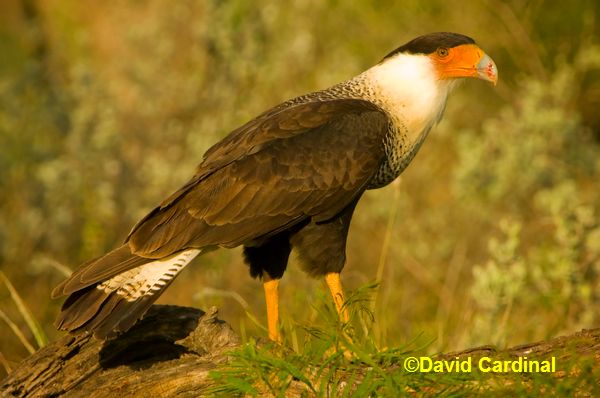
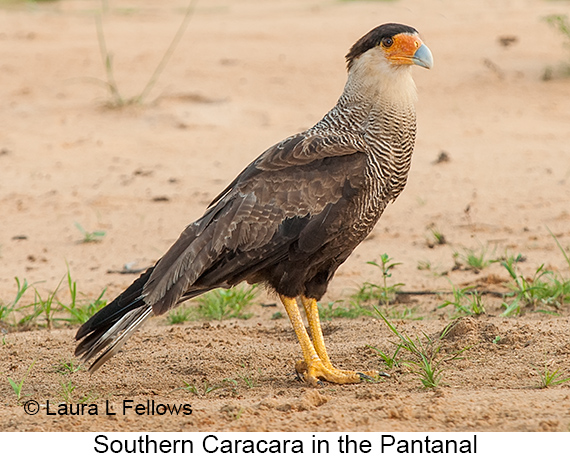
In this instance, I'm going to talk a little bit about how my Crested Caracara ink drawing was done.

First, I gather a nice library of reference photos, these days, mostly performed through a Google search, for both the common name and the scientific name. Generally, I end up with about 6-10 photos that compromise one drawing. This prevents the drawing from looking like any particular photo, and also includes enough detail to work up each part of the animal.

In this case, these photos here and here were used for the head. This one for the wings. Also this one and this one for the wing feathers. This one was referenced for the wing and tail feathers.

Two photos were used as the main references, which give the majority of the look of the final piece. This one was one I used a lot for the pose, wings, shadows, and patterning. Here's another I used the most for the pose and the feet.
A few other photos also played minor roles in detail references.

To save myself the trouble of sketching, then retracing onto tracing paper, I skip a step and sketch directly on tracing paper. The initial sketch is loose and light, with a 2H pencil, lots of erasing and correcting until I get something that looks like it matches all the references I used. Then, I make a few more small corrections in the process of transferring the image onto bristol using graphite transfer paper. All the dark lines on the sketch are the final lines that were transferred to the bristol paper.


Next step is to ink the transferred sketch. I generally start near the head, outlining the shape with a Hunt 512 nib. Anything that still feels strange at this point is erased and redrawn with the 2H pencil. I do most of the interior details with the Hunt 102 nib. Any stippling is done with a Micron .05 pen. And the end result:


As requested, a couple of close-up images.
The upper wing:


And the close-up of the head:

Thursday, November 12, 2009

Back to Black

While I have done some color pieces for work, it's all been concept for projects that aren't public yet, so here's a few more ink spots that I've done lately. On the homefront, I am working on a couple of pieces, but they are still WIP.

Here's a whitespotted bamboo shark:


A porcupinefish, no species in particular but the markings were modeled after a Diodon holocanthus:


A male American Kestrel:


A Harris's Hawk; I feel like the head's too big:


And while not strictly black and white, it is fairly monochromatic. Here's an octopus done in Adobe Illustrator in the style of Live Trace for a volunteer name tags board:


Working on a Crested Caracara pen and ink drawing now. Otherwise, mostly working on new signage.

Sunday, September 06, 2009

Mural Madness!

Finally getting around to posting pictures of the murals I worked on this year.
The murals are © to Aquarium of the Pacific, but the photos are © to me.
Here's an overview of the Watershed Exhibit mural:

You can see that the mugwort's starting to overgrow the right side of the mural.
These days it's 6 ft tall and completely covers the bottom half of the mural.

Here's a shot of the left side of the mural:


The middle of the mural:


Several close-ups of some of the animals:
Great Blue Heron


Harvest Mouse


Black-Neck Stilt


Here are some photos from the Shark Zone murals on Harbor Terrace. While the watershed mural was painstakingly scientifically accurate, Shark Zone was done to brighten up the area. While the colors are truly that bright on some of the different species, I punched up some colors and shifted others. The mural is also a mix of tropical and temperate species.
The main part of the wall mural on the left wall:

The other side, on the right wall:

The two computer murals printed out as stickers. The one on the food cart is a combination of a watercolor whale shark with some Photoshop filters and a lot of copy-paste fish. That one had a short deadline and was done in a day. The one on the window is a Photoshop creation based on a rough pencil sketch. All the corals are put in there more for aesthetics than for the actual zone and place they grow in:

Here's the actual computer image of the window image, "Harbor Reef."


Some close-ups of the wall mural:
bat ray


bluespotted ray


Anemone! Based off a whitespotted rose anemone.


Hope you enjoyed your tour of the recent murals I worked on. I finally have them up!

Monday, July 20, 2009

From Concept to Completion

Here's a small insight into the process of creating a scientifically accurate mural.

Near the end of last year, I was tagged to create a mural for the 42' white wall in our new watershed exhibit. My approach to murals is through the limited experience and experimentation that I've had working at the aquarium and the years of painting on a smaller scale, so my approach is very much my own. I started off the image in Photoshop for the quickness and ease of changing placement.

My first instructions were to copy the mural that was done on the fountain in the front, so I after a couple of revisions of bird placement and how much of the mural to copy, this is the mockup I made:


The thought was that the image didn't really do what they wanted to do, which was, essentially, to cover the white wall and in effect, make it disappear. So the bosses scrapped the idea of copying the fountain from the front, because the shape of it was completely wrong for the wall in the back and it would have taken some major distortion and extension to work with the dimensions of the wall. Instead, I was given free reign to create my own image, a sort of "do whatever you want" with a similar idea. So I decided to put some of the garden plants on the wall to create the illusion of an extended garden and since it's an aquarium, an ocean scene. I also carried over from the fountain mural the locally found endangered bird, the Least Tern, as the main focus of the mural and few native butterflies to round out the animal population:


Once given an image to work from, my bosses decided on the theme "Urban Wetland," to reflect the characteristics of the local wetlands and the interactions of people with the natural world. It's a large part of what the aquarium wants to convey through the new watershed exhibit, which this mural is a part of. So another couple of revisions deciding what should compose the "urban" portion and this was the result:


So we had power lines, cars, and a shopping mall to represent the urban part of urban wetlands. The next request was to see a 20% tilt in the "camera angle" of the image in order to see more of the wetland:


For the sake of scientific accuracy, since this was no longer an ocean scene but a coastal bluff overlooking a wetland, the brushy hill was converted to a sand dune, a prime nesting spot for the Least Tern. Also, an additional revision called for the inclusion of an osprey, a common bird of prey, hunting for fish in the wetlands:


Now, I had a full collection of local residents of the wetlands, mostly birds, because they are the most easily seen and recognized. The image was sent off again for review, this time including a professor that was familiar with the local Los Cerritos Wetlands. The species list was updated to include more of the local plants and animals.

The final concept image can be found in the previous post.
Next post: Photos from the actual finished mural.


Tuesday, April 07, 2009

Instead of Wallpaper

A while ago I posted a couple of images I did for a mural of the Sea of Cortez, the Vaquita and the totoaba. I finally got around to taking a photo of the mural. Here's the main section. It's about about 12' wide and 9' tall. There's another portion on the opposite wall where the Baja peninsula is blown up, but the lighting is pretty bad in that gallery.

Currently working on another mural, larger than the last, at 42' x 8' though the wall dips down to 5' for about 20' of it, so that's why the mockup has a strange shape. I will post more about the process as this mural goes along.